
We Have Marvelously Unreliable Memory
We humans are really bad at remembering, and we usually don’t know just how bad. Let me show you what I mean.
Imagine a major event in life that is memorable. Let’s suppose that event took place in, say, 1995 (I’m aging myself a bit). And let’s imagine you are recounting that event to a friend in 2026. How sure are you that you’re getting the details right? I’m not talking about the granular, insignificant details. I’m just talking about the general facts of the incident that are load-bearing to the truth of the story. If you’re old enough to have formed memories 30 years ago, you’re probably certain you can remember the general details. You’re confident in who was there, what the vibe was, and what the atmosphere felt like. This exact thing is true of me.
There are two major reasons this confidence is often misplaced, and I’m going to show you both of them happening to me.
- Our interpretations and our narratives are heavily colored by what’s already parked in our minds ahead of time.
- The memories get rewritten in the retelling.
I’m Sure I Got This Right
I remember a family get-together that took place in 1995. I would have been a kid at the time, but I remember it with high-res detail. Over the years, I’ve told it several times to other people because it’s a good, wholesome, funny story about something that happened with my family. It goes something like this:
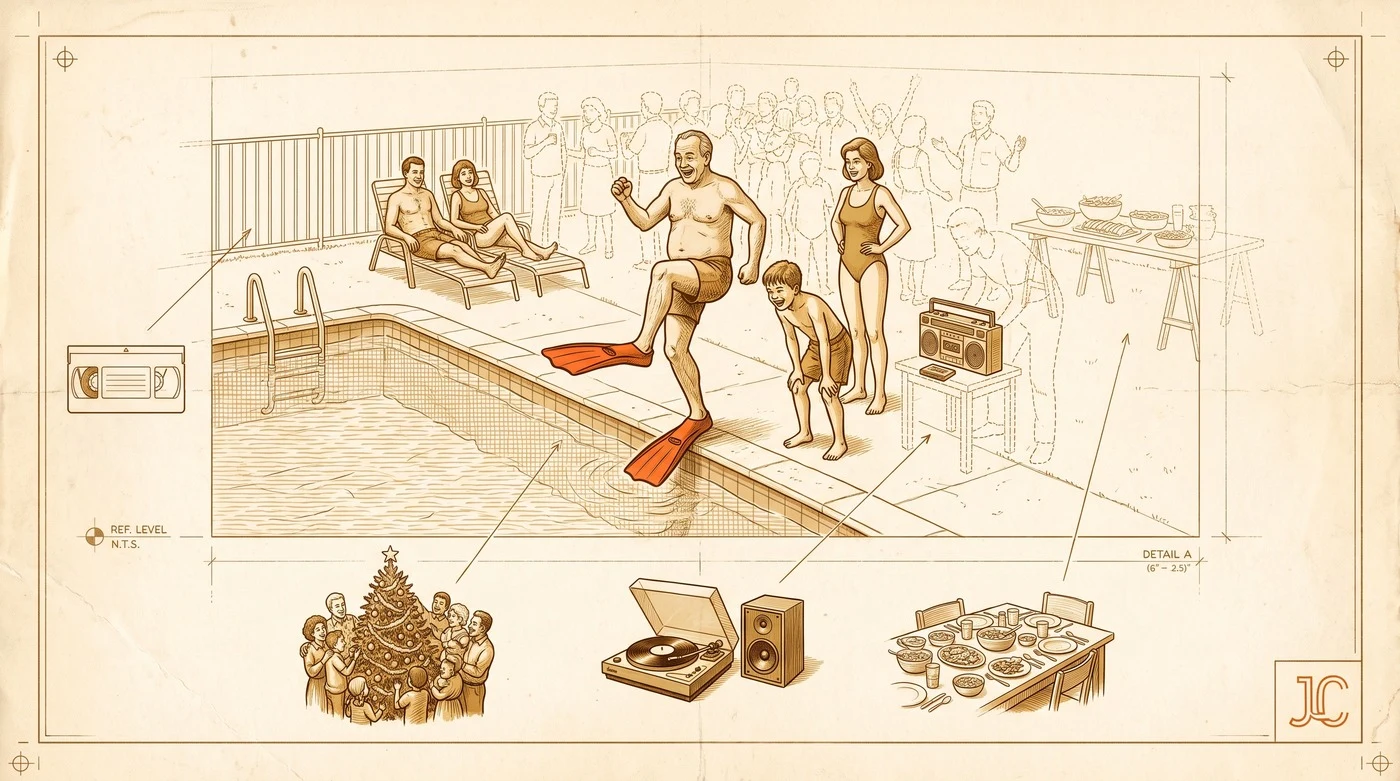
My grandparents’ house had a swimming pool, so all summertime get-togethers happened at their house. One summer day, the backyard was packed with relatives from near and far. Cousins, aunts, uncles, great aunts and uncles, my other set of grandparents. Basically everyone important in my life was there. One of my uncles had an Elvis greatest hits album playing on a boom box and people were swimming and dancing around to jailhouse rock.
My Pappaw was a very funny man, always making everyone laugh. Out of nowhere, he came running out of the back of the house with a set of diver’s flippers on his feet, running like a duck as fast as he could! He had to lift his feet a foot off the ground with each stride so as not to trip himself and fall. The entire family laughed so hard that several people accidentally spit out their food, overcome with laughter at the sight of my Pappaw running like a crazy duck to jump in the pool.
I’ve told the story at least 20 times. I’ve even demonstrated his running with the flippers on our own summer pool days with my kids, and everyone belly-laughs. And that’s the key part you need to remember for this to make sense later. I’ve told the story over and over through the years. Don’t forget that part.
Inconvenient Evidence
About five years ago, we found some old VHS tapes. A treasure trove of home videos from the “glory days.” And what a fantastic celebration I had when I discovered that the moment from 1995 was captured on a home video.
I rushed out, bought a VCR and the adapters necessary to hook it up to a TV that was not designed to be connected to a VCR. I popped the tape in and pressed play, eager to discover whether or not the tape’s label had led me down a disappointing road, or if it was going to deliver on its promise. And it delivered. Five seconds after pressing play, I’m watching my Pappaw come out the back door of the house with the flippers on his feet!
Only… something is way off. First, there are only 5 people in the scene, and I’m one of them. Secondly, he’s not running at all! He’s just walking slowly with the flippers. But I’m sure everyone there is laughing really hard, right?
Not really.
The only one laughing hard is… me. I’m laughing. Because it’s funny to me. Everyone else definitely sees the humor, but I’m the only one “belly-laughing,” probably because I’m about 9 years old!
But no one is spitting out food because of their laughter. Relatives from far away are not present. There’s no music playing in the background, so Jailhouse Rock was a total fabrication of my mind. Where did those parts come from?
This feels like an episode of The Twilight Zone. I was there. I remember what happened.
I guess somebody has made a fake tape and hired actors that look just like everyone else?
Hardly. The problem is that my memory of the event is heavily modified by the other memories that were already parked in my mind. I remember this day took place, but my memory is heavily influenced by what was true of that time frame in my life. And there’s evidence for how things really were, because I watched the rest of the tape too.
There are clips from Christmas in that same year where there really is music playing, food in every room, people packed around the tree, and relatives from near and far. Every ingredient I “remembered” is on the tape. There actually was a tremendous amount of laughter, and very often there were large family get-togethers where every known blood relative was present. Just not at the event in question itself.
It turns out my mind didn’t invent anything! It did something far more interesting – it took real things, real music, real food, real crowds of people who were really there, and it built them into a memory where they never happened. An entire narrative was created to fit what was already in my mind using facts that were correct about that house, those people, and that time in my life.
We Remember Remembering
I told you to remember the detail about how I’ve told this story multiple times over the years. Up until I found that tape, I was telling this story with deep-seated conviction that it was accurate and true. No one on earth could have ever convinced me that I was remembering things incorrectly. And that’s because I was not actually remembering. I was remembering remembering. In other words, when I was replaying the incident in my mind, I wasn’t pressing play on the real incident. I was pressing play on the version that I remembered later – rewatching it in my mind from when I retold it in 1997, or in 2002, or in 2017.
This is explained well in Gillian Butler and Freda McManus’s Psychology: A Very Short Introduction from chapter 3:
…I can no longer tell the difference between my ‘real’ memory and what I remember remembering later. Memories once told can be changed by the telling, which may explain how we sometimes come to believe our own lies.
But why is this? Why does our mind remember remembering rather than remember the actual thing? I have a theory, and science tells me I’m not alone in that theory.
I wonder if our minds are like every other part of us – designed to protect us. Our legs can carry us upright because our ancestors needed to outrun whatever sought to prey on them. Our bodies can cool themselves through sweat so we can lower the temperature efficiently from such a run. We have arched feet and large leg joints to absorb shock and store energy with each stride. And when we sense emotional danger, distress, discomfort, or unease, our minds adapt and reorient our mental processes such that we survive optimally.
What I’ve just described is not universally applicable, obviously. Plenty of people suffer actual trauma of which they remember every detail. Likewise, there are very interesting cases of those rare people who in fact remember everything with clarity and accuracy. I’m only speaking here of regular everyday memories, and any discussion about trauma and its associated memories or of unique and anomalous cases requires deeper observation than I’m informed enough to have.
Meanings Over Details
But from my own experience, I think the most important and valuable conclusion is that there’s a reason we remember the way we do, and it has to do with meaning. My flawed memory of the story has brighter colors and warmer undertones of joy than the real one, and that particular summer wasn’t serving up halcyon days like the memory seems to indicate.
It was the year my parents split up. It was also the year I would start a new school in a different town and struggle for a short time to make friends. I was developing insecurities about my appearance as I had suddenly started getting chubby. I had heard about a friend from my previous school who was tragically killed in a car accident. Things were bizarre and times were different for me.
To be clear, I didn’t have a difficult childhood by any standard. We all know people who endured genuine hardship in their formative years, and I wasn’t one of them. But there’s no good purpose in pretending something wasn’t difficult just because it wasn’t as hard as what someone else endured. Measured against the rest of my childhood, that summer carried real pain and disappointment.
And there are other memories that aren’t as positive, which I can now interpret through an adult lens and see that my family was like any other: flawed, problematic, dramatic at times, and not always kind to one another. You know… normal human stuff. But that “stuff” isn’t the meaning of that time, nor is it the important takeaway.
There are some important details that I am remembering correctly: my family was good, and this was a tremendously safe and nurturing place. My memory is correct in that regard, and the evidence is on the tape. Laughter was normal, gatherings were frequent, and my Pappaw really was insanely funny. Those parts were all true.
Because our mental faculties are hard-wired to survive and thrive, my memory is heavily affected by what’s already there – by the good things that protected me and carried me through an otherwise disappointing and troubling season. The meaning of the memory is the part that I should remember, even if the details are off to some degree… or by a lot.
That’s why I think it’s more important to remember the meanings that come from the memories – and to use those meanings as we think, process, and communicate with others – than it is to worry about whether we’ve got the granular details of the story right.
Sure, there was no Elvis on a boom box (there actually was Elvis playing at another pool-side event, which explains the memory), no food ejected by an eruption of laughter, and no crowd of relatives that day. But the meaning of the story is still fabulously true – that Pappaw was funny, that family was together, that difficulty was only temporary, and that my perception of the time (and consequent inaccurate recall of details) held the office of rescuer in the developing mind of an otherwise disappointed and confused kid. The essence and meaning of the memory is tremendously more consequential than everything else, and for that reason, I think I remember it just fine.
But we humans really are bad at remembering things.