We All Have Unrealized Dreams
What’s the thing you want to do – that you wish you could do – but you just don’t know whether you would or could?
I have a toolset to help you get your mind around doing anything. If you have no idea how to go about accomplishing things, I believe this will unlock it.
It’s held up by scientific (psychological) observation, and you’ve probably never tried it.
Also, it will cost $0.
I’m talking about doing big things and small things. Things like getting 100k followers on TikTok. Maybe you want to pass an IT certification, or get a job, or buy a house. It doesn’t matter what it is. Your mind will carry you to the finish line.
There Are Three Supplies You Will Need
- Claude or ChatGPT or Grok or Gemini. Any of them will do. Just pick an AI chatbot.
- You will need to know about a psychological concept (I’m going to tell you about it).
- You will need a bag of Reese’s peanut butter cups.
You don’t have to use the peanut butter cups, you can choose something else, but if you don’t like peanut butter, we’re not friends.
So, if you have no idea how to go about accomplishing your dreams, this is going to unlock it. And it’s all based on the science of what’s going on upstairs in the old noggin.
Unrealized Dreams and Desires
There are lots of reasons people don’t do the things they want to do. Maybe they don’t believe they can. Maybe they don’t know how. Maybe the figuring-it-out part is overwhelming and watching a TV show would be more rewarding.
And that’s what the whole thing centers on: a properly executed reward system.
The Psychology You Need To Know
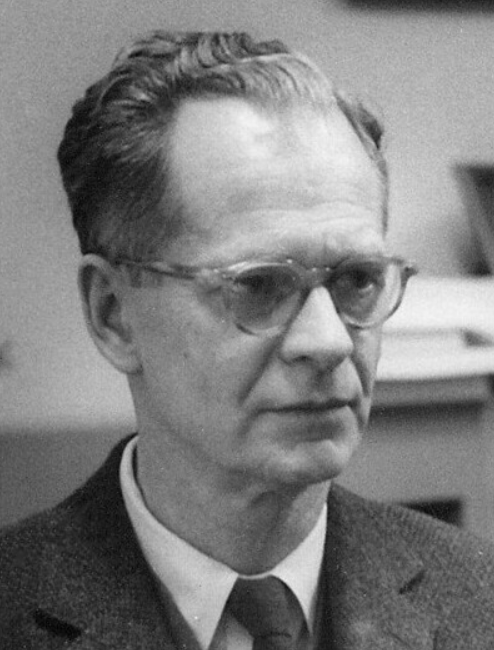
I’ve been reading this book, The Behavior of Organisms by B.F. Skinner, the brilliant behavioral psychologist who wrote about a psychological concept known as “operant conditioning,” and more particularly “intermittent reinforcement.”
The concept is really well summarized in this fantastic book Psychology: A Very Short Introduction, and basically it goes like this:
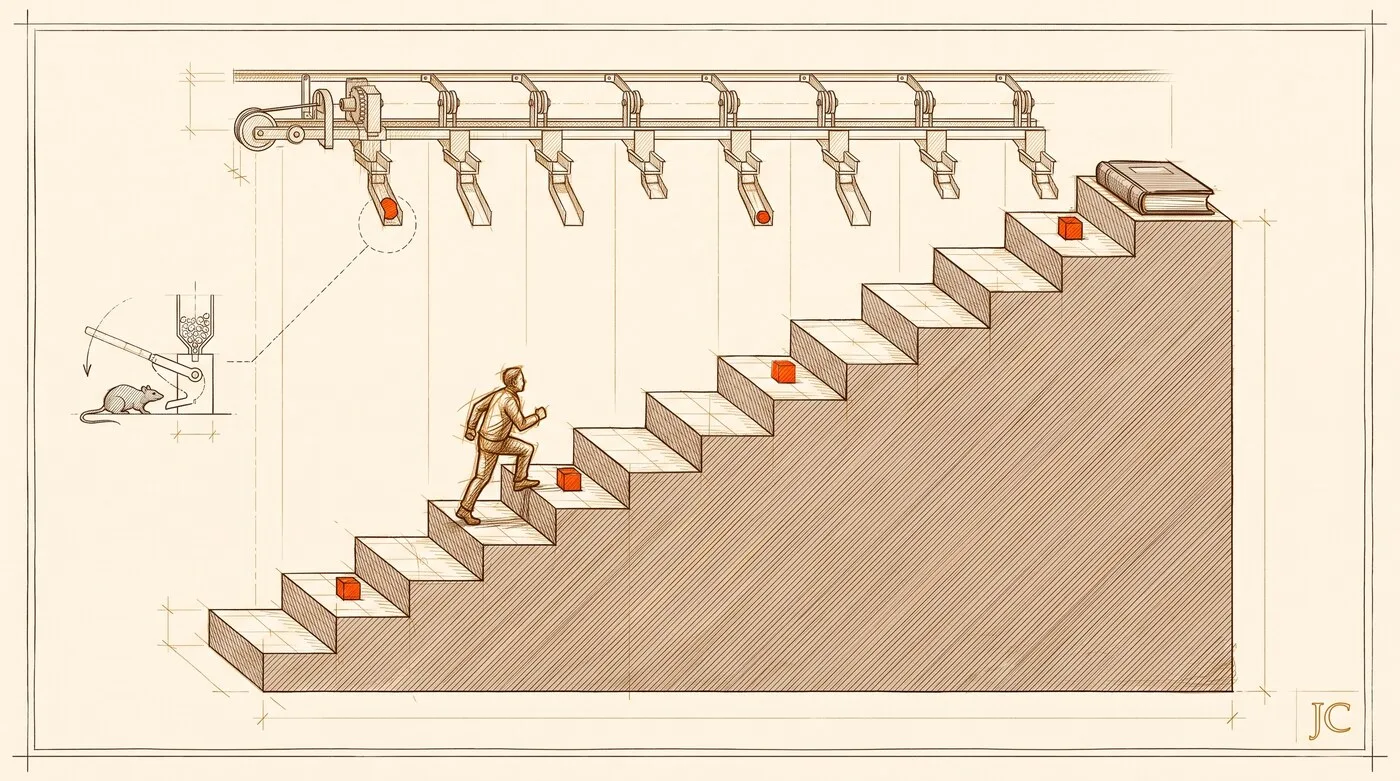
…if an action is followed by a pleasant effect (a reward) it will be repeated – whether performed by a man or a rat. If pressing a lever brings with it a food pellet, a rat will learn to press the lever. The hungrier it is the faster it will learn… The rat will ‘work’ hardest if the pellets arrive intermittently and unpredictably… and less hard if the pellets arrive after the same amount of time whatever the rat does. Hence, people paid at a constant rate for doing boring, repetitive work quickly lose motivation in comparison to those paid piece-rate.
Let’s break that down: the lab produced evidence that rats work the very hardest to get what they want when the reward arrives at an unpredictable time. That’s fascinating! They worked hardest and did the hard things when they had no idea when the reward was coming.

We could have a very long discussion as to why that is, but the fact is true regardless, not just for rats, but for the human species as well.
Evidence shows that we too work the least hard when we know exactly when the reward is coming.
Let’s put this information to work for us. Here’s how you accomplish absolutely anything in 4 steps.
Step 1: Identify the what.
What’s the thing you want? Whatever it is, it should be hard enough that it requires help, it should take time (more than a few minutes), but it should be approachable enough that you can actually do it as your first thing.
Let’s say I want to read a book that is 700 pages, spread across 10 chapters. So every single chapter is a big undertaking! This is a good choice for Step 1.
Step 1 done. I have my thing, and my “what” is decided.
Step 2: Choose the reward.
Choose some object or activity that you derive a lot of pleasure from, and make up your mind that you’re not going to enjoy that thing anymore unless your thing from Step 1 is accomplished.
Step 3: Break it into chunks.
Break your thing down into multiple chunks. The size of the chunks should be no larger than what you already know you can do. So if you want to run a mile, but you are 150 pounds overweight, you’re running to the end of the driveway. It doesn’t matter what it is. Just break it down small enough that you know you can do it.
Step 4: Hand the job to your chatbot.
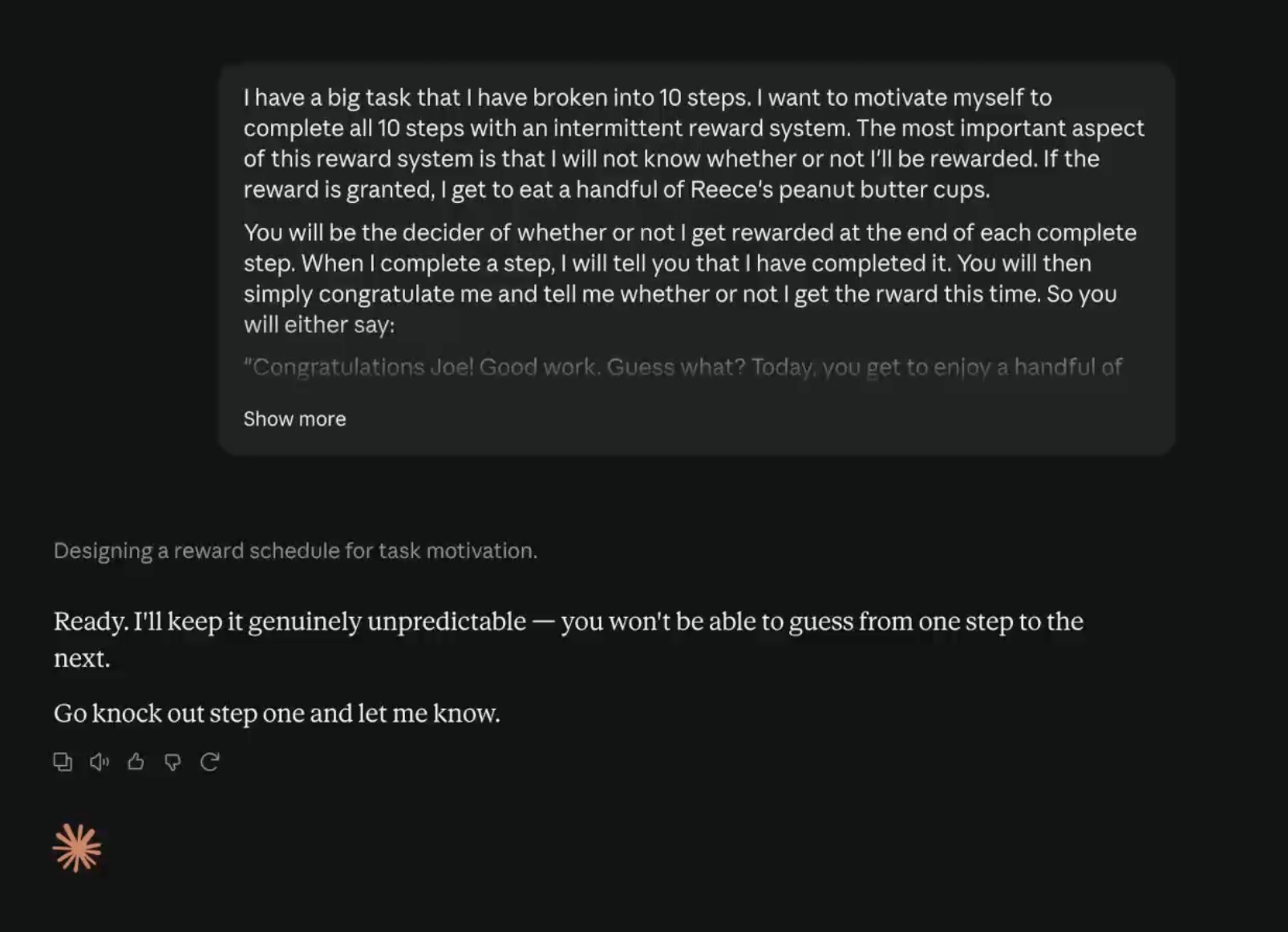
Go to your AI chatbot of choice, and hand it these instructions:
I have a big task that I have broken into 10 steps. I want to motivate myself to complete all 10 steps with an intermittent reward system. The most important aspect of this reward system is that I will not know whether or not I’ll be rewarded at the end of each step. If the reward is granted, I get to eat a handful of Reese’s peanut butter cups.
You will be the decider of whether or not I get rewarded at the end of each completed step. When I complete a step, I will tell you I have completed it.
You will then simply congratulate me and tell me whether or not I get the reward this time.
Okay, so let’s do mine. I’ve got my 700-page book. I might be thinking I can’t read this whole book. But I know I can read chapter one.
So I get to the end of chapter one. Let’s talk to Claude.
Me to Claude:
I finished chapter 1.
Claude to Me:
Congratulations, Joe! Guess what? You get to eat a handful of Reese’s peanut butter cups!
I slowly enjoy my snack.
Me to Claude:
I finished chapter 2!
Claude to Me:
Nice work! Keep going, and let me know when you finish chapter 3!
Me to… myself:
Oh man! Chapter 2 was very long. I was really hoping for a mouthful of buttery Reese’s peanut butter.
Do you know what this does to me? I want to read chapter 3. I’ve got this game going with my chatbot, and I’m now invested – not just in the game – but oh yeah! I just realized chapters 1 and 2 were really great. Let’s check out chapter 3.
Of course I could eat the snack anytime I want to. But I made up my mind ahead of time that I’m only going to eat them when my chatbot says I can eat them. The idea here is that I don’t know when the reward is coming. And the most valuable part of this entire system is that the snack is just a snack. But the side benefit quickly becomes the main thing. I’m reading the book. I’m doing the thing. And I’m eager to enjoy the possibility of an immediate reward, not to mention the larger overarching and lasting reward of having done the thing that I previously was unable to do.
At this stage, if you’re thinking this won’t work, remember: unpredictable reward is scientifically proven to successfully modify behavior. It’s just how our brains work. It’s no different than the laws of physics. Things in motion tend to stay in motion. Gravity holds you on the surface of the earth. The speed of light in a vacuum is a universal constant. Your brain responds to intermittent reward. It’s what keeps the lover in constant pursuit of the fickle love interest.
And that’s my favorite thing about this methodology.
Name the thing you wish you would do but can’t seem to make yourself. Build a reward system that is unpredictable.
You’ll look up one day and say to yourself, “Wow. I did the thing.”
Sources
- B. F. Skinner, The Behavior of Organisms: An Experimental Analysis — D. Appleton-Century (1938). Full text via the B. F. Skinner Foundation: https://www.bfskinner.org/wp-content/uploads/2016/02/BoO.pdf
- Gillian Butler and Freda McManus, Psychology: A Very Short Introduction, 2nd ed. — Oxford University Press (2014): https://global.oup.com/academic/product/psychology-9780199670420
Author

My name is Joe, and I run an IT and Cybersecurity company. Off the clock I’m a pianist, an avid reader, a student, a husband, and a dad. I write to think out loud — mostly about technology, history, art, and faith, and the places they all keep bumping into each other.