
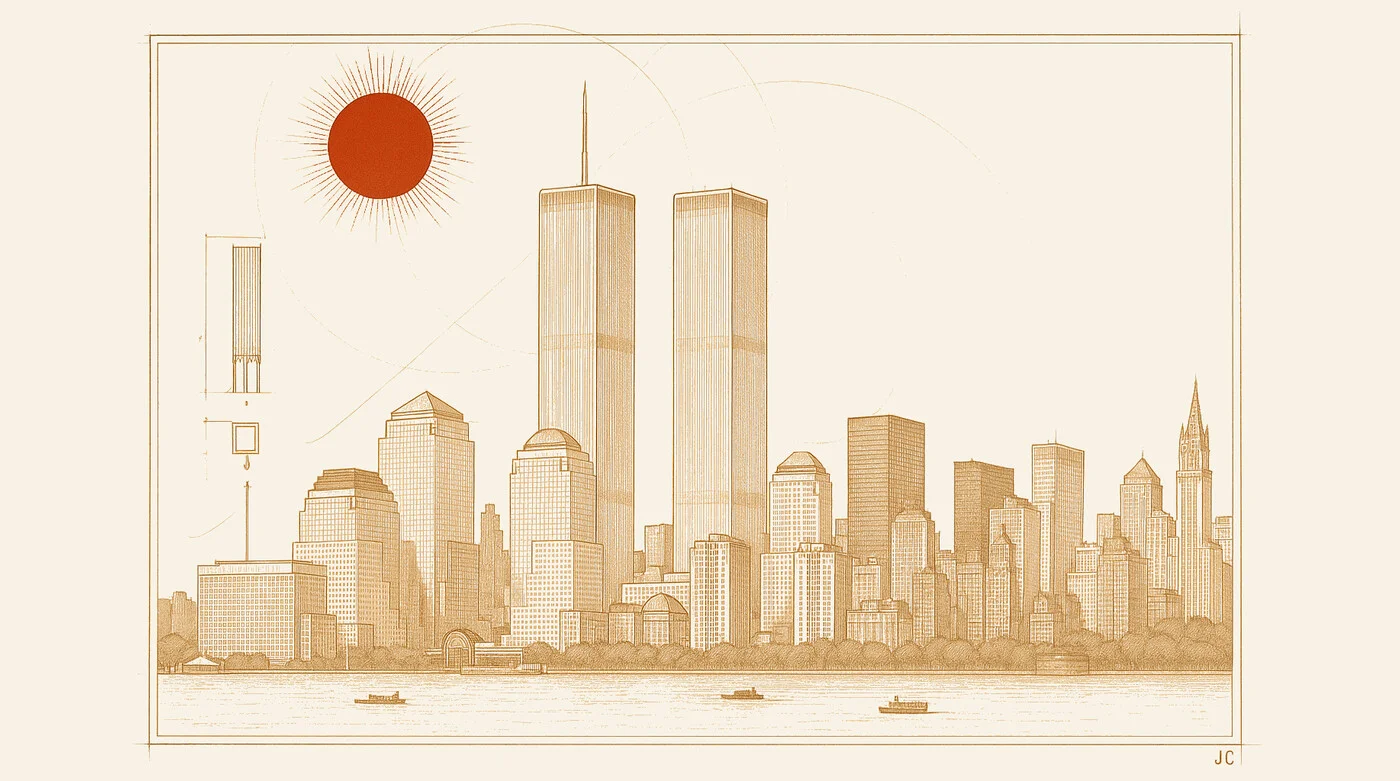
It was a normal 10th grade Tuesday morning until a hush fell over my high school. Every television was tuned in, and that’s how I learned what was happening in New York City. Like everybody who was alive that day, I tend to believe 9/11 is burned into my memory with perfect clarity. The reality is that our confidence in a memory like that one holds steady while its accuracy quietly drains away. But I remember the hush.
Twenty-five years later, there is still an enormous amount of attention on the horror of that morning and on the questions we are still asking about it. But what has always stood out to me is something else. It’s the humanity with which the victims suffered.
We have a few dozen voice recordings from those who had a working phone, a minute to spare, and somebody to call. I used to think these were just calls made to say goodbye, as though the victims had concluded there was nothing left to do but accept their fate. But that’s not what’s on the tape. Most of them were trying to live. Betty Ong, a flight attendant on the first plane, got through to American Airlines at 8:19 and spent twenty-five minutes relaying the hijackers’ seat numbers so somebody on the ground could act on it. At the World Trade Center, victims were reporting which floor they were on and asking for rescue instructions. They hoped the stairwell would clear because they believed help was coming. The passengers over Pennsylvania were organizing a way to take the cockpit back, and I’ll call that heroism without hesitation. But heroism is not what I’m describing here. They were fighting for the next minute of their lives.
The part that astounds me to this day is that in the middle of fighting to survive, an extraordinary number of them spent their last available moments reassuring somebody else, trying to save someone else, and living those moments with intentionality and purpose. You listen and watch, expecting to see people paralyzed by despair, and for the most part it isn’t there. They are overwhelmingly active. You have Brian Sweeney on the plane that hit the South Tower leaving a message for his wife Julie that he ends with “I’ll see you when you get there.” He is a couple of minutes away from dying and he’s comforting her about it. You see clips of an injured man literally carrying another injured man to safety.
It’s hard to imagine gasping for your last breath. It’s even harder to imagine spending that breath on somebody else. But many of them did just that.
About 200 people went out the windows, nearly all of them from the North Tower. I used to think they jumped. That’s what it looked like on TV. The New York Medical Examiner’s Office will not use that word and I think they’re right. The word jumping indicates they had a choice and I don’t think these people had such a luxurious commodity as “choice.” That’s why every single one of their deaths was ruled as homicide rather than suicide. They were forced out by heat and smoke that other men put there. It seems we’ve tiptoed around those 200 people for a quarter of a century as though something shameful happened to them. Nothing shameful happened to them. Something despicable was done to them.
And that brings me to the thing that I most want to get right.
I don’t believe the man who left the calm voicemail or saved another person was worth more than a man who might have panicked in the stairwell and shoved past somebody slower than him on his way down. And I can’t show that man to you. He isn’t written down because the only people whose last minutes we have are the ones who had a phone and the composure to use it or the ones whom a camera happened to capture in the lower levels of the buildings, which means every example I’ve given you is drawn from the people who happened to leave a record. Our hypothetical man (of whom some iteration certainly existed) didn’t, and it’s not a fact about his worth. It’s a fact about what survives. Some of them had 90 seconds and a telephone. Some had no warning at all and were gone before they knew anything was wrong. Whatever it is that makes a person valuable was already entirely true of all of them before that Tuesday morning, and 19 cowards with box cutters had no power to revoke that truth. Honor, dignity, and purpose in life are not something you earn in the last minute. You either have them the whole time, or not a single one of us ever had them.
Even still, those voicemails wreck me.
I used to think the shared value we all extracted from this tragedy was one of unity and value for life. Some of that sentiment was real, but I fear almost none of it held. Within four days, a man named Balbir Singh Sodhi was shot to death outside his Arizona gas station, where he was planting flowers, because he wore a turban. Hate crimes against Muslims went from 28 in 2000 to 481 in 2001. Whatever we thought we agreed about in terms of what should happen next appears to have been undone inside of 18 months, and we’ve been arguing about it ever since. If unity was the only lesson we learned, we failed almost immediately.
As much as I’d like to claim we learned something permanent, I think some of the valuable lessons we learned are too soon forgotten. But for a time, a lot of us could see something clearly that we normally cannot see, which is that the people standing near us are worth an incalculable amount, and that this is true of them whether we ever notice it or not.
That’s what September 11th means to me 25 years later. If suffering can be avoided, we obviously seek to avoid it. But when it is thrust upon us, it tends to reveal a central human truth that was always there with or without the suffering – that life is valuable, that it should be preserved and protected, and that humans always have meaning and purpose. And meaning and purpose are usually thought to be shown in how we live, but 9/11 reminds me they are often most powerfully shown in how we suffer – in how we die. The victims of that day had every reason to believe the meaning in their lives had reached a conclusion. But what we actually see them doing suggests the opposite. Some fought to live, some comforted the people they loved, and some quite literally rescued others while they themselves had no guarantee of survival. They showed that meaning and purpose exist not just in our living, but in our dying.
I can’t get past that. I can’t unsee that. I don’t want to.